January 1, 2005 marked the end of textile quotas in the amount of textiles that North American countries and Europe can purchase from a single country, as per World Trade Organization agreements. This frees trade worth about $300 billion and throws open the lucrative Western markets. The complex 40 year old Multifibre Agreement (MFA) capped the textile exports of developing countries to resource rich nations. These were self defeating in their purpose and limited textile growth and competition. The challenges introduced, however, have far reaching implications.
Large textile producers like India and China have the most to gain, while smaller, yet significant producers such as Bangladesh and the Phillipines could see a big hit in their revenues from textile sales. A number of textile workers in these smaller countries have already lost their jobs,
Officially, India is aiming at a target of $50 billion in annual textile exports by 2010, about four times the current figure of $14 billion a year. Commerce minister Kamal Nath expects a 50 per cent growth in exports to the freed US and the European Union markets in the very first year. Textile minister Shankarsinh Vaghela projects India’s apparel exports to double in the next two years.
China has even larger aspirations, thanks to greater economies of scale. While most economic numbers out of the official Chinese apparatus are somewhat questionable, as proved by the Economist in 2003, there is no doubt that for much of the world's retailers, China has become the back end of the global supply chain. Chinese textile sales to the US alone rose 30% in 2004
As far as labor costs go, as a proportion of the total cost, the labor cost in India is only 6%, compared to 10% in China, 19% in Mexico, 22% in Thailand, 29% in Turkey, 51% in South Korea and 69% in Germany. Only Indonesia has a lower labour cost of 5%. India has a capital cost advantage as well. The proportion of capital costs to gross output is 6.7% in India in the textile industry and 7.8% in garment making, while those in China are 12.2% and 12%, respectively.
China excels in the manufactured, mass-produced sector. Design is however, a strong element in India's appeal to Western apparel manufacturers. The Indian National Institutes of Fashion Technology churn out nearly 1000 graduates a year. The US International Trade Commision sees India as a significant alternative to China as a source for textile goods. Large integrated mills have been set up across textile parks in India in preparation for this change over.
India has also, significantly, adopted the product patent regime as of Jan 1, 2005 for food, drugs, chemicals and embedded software, keeping safeguards for the common weal. A 'mailbox' application process has been established for patent recognition.
The US textile industry, fearing a flood of cheap Chinese imports when the quotas expire at the end of this year, has been leading an international effort to persuade the WTO to approve a three-year extension of the quota system.
However, WTO members recognise that extending the quotas would unravel a key portion of the 1994 Uruguay Round world trade agreement, which required countries to make difficult trade concessions in a number of sectors. Many of the agreements are perceived by developing countries to be in favor of developed nations, and the developed nations are loath to give up some of their competitive advantages.
Textile makers also expect to improve on their buying power by having to place orders with fewer countries and manufacturers as opposed to the current covert arrangements split across dozens of manufacturers to avoid the quota restrictions.
The significant shifts in the textile industry will take a few years to play out, although the negative effects will likely have their impact very soon, as is usual in economic dislocations.
Update: The WTO has a paper on the global textile industry post the end of quotas (pdf). An overview of textiles under the WTO is also available.
The agreement itself is part of the Uruguay round agreements.
Glenn Reynolds has some thoughts (and a ref to me - Thanks, Glenn) on the implications.
Spear Shaker has a brief from the frontlines of global outsourcing, via Dhaka, Bangladesh.
Sunday, January 02, 2005


Saturday, January 01, 2005
Thirteen Mean Girls
I still cannot believe that I just watched "Mean Girls" and enjoyed it. It was perhaps elitist to have had low expectations before viewing the film, but one is too wary of packaged presentations from Hollywood touting the wares of the fickle god of consumerism.
"Mean Girls" was no such film. It conveys a number of positive messages without being trite, is funny and endearing, and most of all, entertaining. The essence of the film reminds one of the recent Amazon Theater short film "Portrait", where a frumpy woman discovers that her inner beauty is brought to the forefront by a photoshoot. While "Portrait" was consumerism-heavy and product-placement thick, "Mean Girls" provides the message that you need to value your friends, study hard and be yourself to be happy. In the end, everyone, even the Queen Bee is happy and fulfilled, in their own, individualistic way.
This is another theme of the film - that fulfilment of the American dream is possible in which way we interpret the dream. A truly multi-cultural and multi-ethnic film, it can also be the posterchild for globalization as a positive force. To arrive is to learn, and the jungle is not very different from public school Americanus. The agglomeration of cultures in the school also illustrates that America is contrary to any perceptions not monocultural at all,and it takes more than just red, white and blue to fill the social spectrum.
Some good digs are taken at various topical themes such as homeschooling, abstinence education and school fashionistas. The math club scenes serve to show there is more to school than make up and making out. The finale of the film is satisfying, in more ways than one.
A film every teen should watch.
A film that every parent with a teen, or prospective teen should watch is "Thirteen". This tale of how easy it is for bad choices to take one off the strait and narrow path is dark, troubled and uncool. Yet, it too, is an important and well made film, dealing with important social issues such as the pressures on single mothers, temptation and self destructive urges in teenagers.
Easy access to drugs is not necessarily a guarantee of doom for an intelligent young person. Many people, when tempted, turn away. The most recent episode of Huff, the Showtime series demonstrated this when Huff's son tastes and then turns away from temptations offered him by his friends, choosing not to steal his father's drug samples. Not every child is so well informed and smart. Often, as "Thirteen" shows, it can be because of inadequate attention by a pressured or distracted parent, although attention may not be enough.
Two films, both different, both important.
Happy New Year
"Mean Girls" was no such film. It conveys a number of positive messages without being trite, is funny and endearing, and most of all, entertaining. The essence of the film reminds one of the recent Amazon Theater short film "Portrait", where a frumpy woman discovers that her inner beauty is brought to the forefront by a photoshoot. While "Portrait" was consumerism-heavy and product-placement thick, "Mean Girls" provides the message that you need to value your friends, study hard and be yourself to be happy. In the end, everyone, even the Queen Bee is happy and fulfilled, in their own, individualistic way.
This is another theme of the film - that fulfilment of the American dream is possible in which way we interpret the dream. A truly multi-cultural and multi-ethnic film, it can also be the posterchild for globalization as a positive force. To arrive is to learn, and the jungle is not very different from public school Americanus. The agglomeration of cultures in the school also illustrates that America is contrary to any perceptions not monocultural at all,and it takes more than just red, white and blue to fill the social spectrum.
Some good digs are taken at various topical themes such as homeschooling, abstinence education and school fashionistas. The math club scenes serve to show there is more to school than make up and making out. The finale of the film is satisfying, in more ways than one.
A film every teen should watch.
A film that every parent with a teen, or prospective teen should watch is "Thirteen". This tale of how easy it is for bad choices to take one off the strait and narrow path is dark, troubled and uncool. Yet, it too, is an important and well made film, dealing with important social issues such as the pressures on single mothers, temptation and self destructive urges in teenagers.
Easy access to drugs is not necessarily a guarantee of doom for an intelligent young person. Many people, when tempted, turn away. The most recent episode of Huff, the Showtime series demonstrated this when Huff's son tastes and then turns away from temptations offered him by his friends, choosing not to steal his father's drug samples. Not every child is so well informed and smart. Often, as "Thirteen" shows, it can be because of inadequate attention by a pressured or distracted parent, although attention may not be enough.
Two films, both different, both important.
Happy New Year
Friday, December 31, 2004
Disaster Relief
Stepping aside from the unfortunate politicking, it is our human duty to help out people in need. The disaster in Asia - one of the ten worst known natural disasters in human history - has seen an outpouring of support for the victims. Companies, individuals, non-governmental organizations and governments are doing their utmost to get aid where it is needed.
Here are a few places to start - Feel free to add your own as comments to this post. As always, be careful in choosing a well known charity rather than what may seem as a shady operator - and stay away from blogroaches.
1. The Red Cross, and allied organizations are doing yeoman service in disaster relief.
2. Amazon has a convenient One-click link for contributions on their home page - 100% of the contributions go to the Red Cross
3. Musicians have formed charities and will be doing relief concerts next year - visit musicforrelief.org to contribute through their site
4. The UNICEF organization is working to provide relief to children affected by the disaster - they have an ad up on blogcritics as well.
5. The Salvation Army is taking donations
6. The SEA-EAT blog is a good resource for info and volunteer/relief sites
7. For India, you can contribute to the Prime Minister's Relief Fund (I will add additional country-specific funds here soon)
8. Wikipedia has a load of information, beginning with the main page on the 2004 Tsunami and Earthquake. The humanitarian response wiki is informative
9. Most large corporations are making contributions, and may have matching gifts programs.
10. If you have the time, money and inclination (or geographical proximity), head on over to a relief center in the disaster region and lend a hand.
Here are a few places to start - Feel free to add your own as comments to this post. As always, be careful in choosing a well known charity rather than what may seem as a shady operator - and stay away from blogroaches.
1. The Red Cross, and allied organizations are doing yeoman service in disaster relief.
2. Amazon has a convenient One-click link for contributions on their home page - 100% of the contributions go to the Red Cross
3. Musicians have formed charities and will be doing relief concerts next year - visit musicforrelief.org to contribute through their site
4. The UNICEF organization is working to provide relief to children affected by the disaster - they have an ad up on blogcritics as well.
5. The Salvation Army is taking donations
6. The SEA-EAT blog is a good resource for info and volunteer/relief sites
7. For India, you can contribute to the Prime Minister's Relief Fund (I will add additional country-specific funds here soon)
8. Wikipedia has a load of information, beginning with the main page on the 2004 Tsunami and Earthquake. The humanitarian response wiki is informative
9. Most large corporations are making contributions, and may have matching gifts programs.
10. If you have the time, money and inclination (or geographical proximity), head on over to a relief center in the disaster region and lend a hand.
Thursday, December 30, 2004
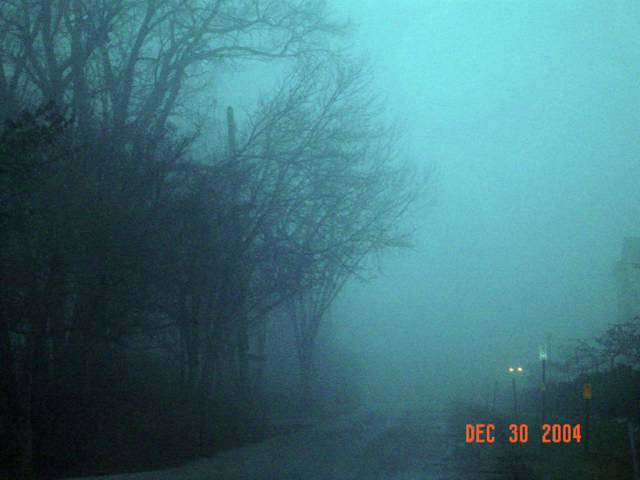
Milwaukee Winter Images
Milwaukee was particularly beautiful today - the lake brought in a stack of fog and mist, the weather was unseasonably warm, if quite moist and windy. Some images I captured...





States Of Fear, Bad Science And Perceptions Of Reality
The plethora of books one reads every year are not, for the most part, difficult to categorize as good, bad or ugly. The bad ones rarely get finished, and the time spent is considered wasted. The really good ones make one think, feel and wonder.
Michael Crichton's new book "State Of Fear" is an ambiguous book to review. It is in fact, a very good book hidden inside a bad one. The master of the application of bad science to thrillers excels in the creation of tense situations that are resolved more by intellect than any deus ex machina devices. The action shifts from place to place, yet retains a sense of unity of purpose and character.
The main thing wrong with the book is the character development. Most of the characters at one time or another merely quote long bodies of science, or pseudoscience, and the motivations of a few key characters are not clarified until it is too late to matter. Peter Evans, minutes away from death, professes his love for Sarah, yet keeps his distance from her for much of the book, seeming to fancy another character, Jennifer. Kenner's knowledge of many fields is set off against his inability to explain the conspiracy clearly to Peter. The deliberate attempt at rendering a political statement cum scientific polemic detracts from the action and distracts the reader.
Peter, an environmental lawyer is shaken out of his placid life by the disappearance of his primary client, a billionaire named George Morton with a certain resemblance to George Soros, in word and deed. He joins a couple of mysterious agents cum scientists in trying to thwart an eco-terrorism conspiracy to set off a series of climactic catastrophes around the world timed to coincide with a major environmental conference. Break-neck action and tense moments abound, although things are mostlyset right in the end, with a minor tsunami to boot. Along the way, the author paints almost the entire environment movement in as much of an unfriendly light as the movement itself characterizes big business. Many of the standard cliches about the environment are questioned, and it is made to appear as if the fears about global warming are unwarranted at best, and specious lies at worst.
It is not difficult to find crooks, bad scientists and unsavory characters in any movement, but that is no cause to doubt the ethics of the movement itself. This is similar to, say, considering all charities criminal because a few of them subvert public funds for 'uncharitable' purposes. As an author, Dr Crichton has the right to choose as crooked villains as his mind can dream up, and not introduce any other better representatives of the profession, but then he risks being classed a second-rate Sax Rohmer with stereotypical Fu Manchu-like characters rather than the masterful writer of good fiction he has shown himself to be.
The publishing company ran a game prior to publication wherein one had to visit a variety of websites scanning for codes and locations in Flash banners. Though this was quite cheesy at the time, reading the book now makes the clues more meaningful. Just for the record, here is the list of clues. This list alone, shows the breadth of the book, without giving away much of the plot.
1. AKAMAI
2. Paris Nord, France
3. Pavutu, Africa
4. Pahang, Malaysia
5. Shad Thames, London
6. Tokyo, Japan
7. Vancouver, BC
8. San Francisco, CA
9. Point Moody, CA
10. TERROR
11. Punta Arenas, Chile
12. Weddell Station, Antarctica
13. Beverly Hills, CA
14. ANGEL
15. Los Angeles, CA
16. Century City, CA
17. FLASH
18. City of Commerce, CA
19. Diablo Canyon, AZ
20. McKinley State Park, AZ
21. Arroraville, AZ
22. Oakland, CA
23. BLUE
24. Santa Monica, CA
25. RESOLUTION
26. Resolution Bay, Gareda
27. Pavutu, Gareda
One of the key aspects of this book, apart from the scientific spin, is the concept of netwar - most resonant with the current War on Terror. This deals with the fear of governments in having to fight an amorphous, loosely connected enemy who changes and shifts focus, and is well-informed & well-funded. In this case, the eco-terrorists employ highly advanced methods to attempt to control the weather, and are tracked by highly covert methods with great difficulty.
Possibly the most compelling character is a USC Professor named Hoffman who puts forth the proposition that the environmental crisis supplanted the spectre of global communism as a means of social control by the 'PLM' or politico-legal-media complex. Sounding like a David Icke-clone, he makes quite a bit of sense in trying to show that state control of society depends on having sources of fear to manipulate the populace. Not a new idea, and one that saw it's most sinister application in the fascist regimes of the twentieth century, and indeed in the historicity argument of Marxism. Hoffmann's best line comes when he talks about 'whole sectors of society' living 'the life of the mind', supplanting universities, who, according to him, are 'the most restrictive environments in modern society' and 'factories of fear for the PLM'. Thus he adduces 'the nation that these institutions are liberal is a joke. They are fascist to the core...'
In effect, Dr Crichton's thesis is that the eco-crisis is a meme gone wild, an idea whose appeal is like that of a fad, fed by legions of academia, politicians and the media. He expands on the theme, directly to the reader at the end of the book, with a few appendices, and the line, possibly tongue in cheek that 'Everybody has a agenda. Except me.'
The science citations in the book are all real, but similar, contrary citations can be found easily enough - such as this one in the NY Times on Arctic warming. This serves to support Dr Crichton's additional thesis that 'all reality is media reality'. An example of good analysis of the pros and cons of one of his examples - the ablation, or lack of it, of glaciers - is shown by this homework assignment from the University of Cincinnati on global warming and the related course. Dr Crichton spends a lot of time in the book warning against allowing bias to affect our perception of reality, as in 'believing' that greenhouse gases primarily cause global warming, while ignoring the effects of urbanization. He fails to exclude bias himself, however, in his reasoning.
The challenge of separating out an individual issue like the question of whether global warming is indeed occuring from the larger pantheon of environmental issues such as pollution and depleting resources is not easy, and possibly pointless. Any person who has seen the pollution clouds of the uber-cities would agree that these are important problems which cannot be dismissed as mere gimmickry by a sinister cabal of environmentalists, determined to preserve their sinecures.
In the end, perhaps it is good that this book is shelved under fiction, for that is where it belongs, despite all the scientific efforts of the author. A thrilling read, with provocative ideas that should induce the reader to do some research of his own into an important subject, more relevant today with the signing of the Kyoto protocol and the recent disasters in Asia.
3.5/5
Michael Crichton's new book "State Of Fear" is an ambiguous book to review. It is in fact, a very good book hidden inside a bad one. The master of the application of bad science to thrillers excels in the creation of tense situations that are resolved more by intellect than any deus ex machina devices. The action shifts from place to place, yet retains a sense of unity of purpose and character.
The main thing wrong with the book is the character development. Most of the characters at one time or another merely quote long bodies of science, or pseudoscience, and the motivations of a few key characters are not clarified until it is too late to matter. Peter Evans, minutes away from death, professes his love for Sarah, yet keeps his distance from her for much of the book, seeming to fancy another character, Jennifer. Kenner's knowledge of many fields is set off against his inability to explain the conspiracy clearly to Peter. The deliberate attempt at rendering a political statement cum scientific polemic detracts from the action and distracts the reader.
Peter, an environmental lawyer is shaken out of his placid life by the disappearance of his primary client, a billionaire named George Morton with a certain resemblance to George Soros, in word and deed. He joins a couple of mysterious agents cum scientists in trying to thwart an eco-terrorism conspiracy to set off a series of climactic catastrophes around the world timed to coincide with a major environmental conference. Break-neck action and tense moments abound, although things are mostlyset right in the end, with a minor tsunami to boot. Along the way, the author paints almost the entire environment movement in as much of an unfriendly light as the movement itself characterizes big business. Many of the standard cliches about the environment are questioned, and it is made to appear as if the fears about global warming are unwarranted at best, and specious lies at worst.
It is not difficult to find crooks, bad scientists and unsavory characters in any movement, but that is no cause to doubt the ethics of the movement itself. This is similar to, say, considering all charities criminal because a few of them subvert public funds for 'uncharitable' purposes. As an author, Dr Crichton has the right to choose as crooked villains as his mind can dream up, and not introduce any other better representatives of the profession, but then he risks being classed a second-rate Sax Rohmer with stereotypical Fu Manchu-like characters rather than the masterful writer of good fiction he has shown himself to be.
The publishing company ran a game prior to publication wherein one had to visit a variety of websites scanning for codes and locations in Flash banners. Though this was quite cheesy at the time, reading the book now makes the clues more meaningful. Just for the record, here is the list of clues. This list alone, shows the breadth of the book, without giving away much of the plot.
1. AKAMAI
2. Paris Nord, France
3. Pavutu, Africa
4. Pahang, Malaysia
5. Shad Thames, London
6. Tokyo, Japan
7. Vancouver, BC
8. San Francisco, CA
9. Point Moody, CA
10. TERROR
11. Punta Arenas, Chile
12. Weddell Station, Antarctica
13. Beverly Hills, CA
14. ANGEL
15. Los Angeles, CA
16. Century City, CA
17. FLASH
18. City of Commerce, CA
19. Diablo Canyon, AZ
20. McKinley State Park, AZ
21. Arroraville, AZ
22. Oakland, CA
23. BLUE
24. Santa Monica, CA
25. RESOLUTION
26. Resolution Bay, Gareda
27. Pavutu, Gareda
One of the key aspects of this book, apart from the scientific spin, is the concept of netwar - most resonant with the current War on Terror. This deals with the fear of governments in having to fight an amorphous, loosely connected enemy who changes and shifts focus, and is well-informed & well-funded. In this case, the eco-terrorists employ highly advanced methods to attempt to control the weather, and are tracked by highly covert methods with great difficulty.
Possibly the most compelling character is a USC Professor named Hoffman who puts forth the proposition that the environmental crisis supplanted the spectre of global communism as a means of social control by the 'PLM' or politico-legal-media complex. Sounding like a David Icke-clone, he makes quite a bit of sense in trying to show that state control of society depends on having sources of fear to manipulate the populace. Not a new idea, and one that saw it's most sinister application in the fascist regimes of the twentieth century, and indeed in the historicity argument of Marxism. Hoffmann's best line comes when he talks about 'whole sectors of society' living 'the life of the mind', supplanting universities, who, according to him, are 'the most restrictive environments in modern society' and 'factories of fear for the PLM'. Thus he adduces 'the nation that these institutions are liberal is a joke. They are fascist to the core...'
In effect, Dr Crichton's thesis is that the eco-crisis is a meme gone wild, an idea whose appeal is like that of a fad, fed by legions of academia, politicians and the media. He expands on the theme, directly to the reader at the end of the book, with a few appendices, and the line, possibly tongue in cheek that 'Everybody has a agenda. Except me.'
The science citations in the book are all real, but similar, contrary citations can be found easily enough - such as this one in the NY Times on Arctic warming. This serves to support Dr Crichton's additional thesis that 'all reality is media reality'. An example of good analysis of the pros and cons of one of his examples - the ablation, or lack of it, of glaciers - is shown by this homework assignment from the University of Cincinnati on global warming and the related course. Dr Crichton spends a lot of time in the book warning against allowing bias to affect our perception of reality, as in 'believing' that greenhouse gases primarily cause global warming, while ignoring the effects of urbanization. He fails to exclude bias himself, however, in his reasoning.
The challenge of separating out an individual issue like the question of whether global warming is indeed occuring from the larger pantheon of environmental issues such as pollution and depleting resources is not easy, and possibly pointless. Any person who has seen the pollution clouds of the uber-cities would agree that these are important problems which cannot be dismissed as mere gimmickry by a sinister cabal of environmentalists, determined to preserve their sinecures.
In the end, perhaps it is good that this book is shelved under fiction, for that is where it belongs, despite all the scientific efforts of the author. A thrilling read, with provocative ideas that should induce the reader to do some research of his own into an important subject, more relevant today with the signing of the Kyoto protocol and the recent disasters in Asia.
3.5/5
Another Loss To The Wave

India's southernmost point, Indira Point was a 100 sq. km. island 51 km from "Point Zero" at Campbell Bay and 140 km from Sumatra. This island has also been known as Parsons Point and Pygmalion Point. It is a favorite nesting site for Olive Ridley turtles, leatherback turtles and other sea fauna. Well, no more. From the Times of India,
Sunday’s tsunami, which altered Asia’s map, nearly changed India’s map too. Indira Point — the country’s southernmost tip — has been washed away.
There is no trace of the half-a-dozen “international scientists” nor the 20-odd inhabitants of this 100 sqkm Indian Ocean island. Just 140 km from Sumatra and 51 km from “point zero” at Campbell Bay, India’s Final Operating Base (FOB) bore the full force of the tsunami...
Nicobar coast guard commander Milind Patil said, “Our vessel Bikaji Kama made it to within 31 km from zero point. They found only four male survivors. Two of them have lost their limbs and the others sustained fractures on the back.” All the four were airlifted to Port Blair. “A Coast Guard helicopter could make just one sortie to Indira Point. It reported the island was below the ocean,” said Patil.
The FOB — with a five-bed hospital, communication equipment, armoury and ship support equipment — is under water.
The Andamans are also of strategic importance - both for India and China, being a series of choke points for access to the Bay of Bengal, Singapore and Sumatra. The islands themselves have little defense against the forces of nature. Good information at Sanctuary Asia on the Islands. No wikipedia entry on Indira Point, though.
Also, somewhat unrelated, Lord Richard Attenborough, producer of the feature film Gandhi has lost three members of his immediate family, including his granddaughter in the tidal wave disaster in Phuket in Thailand, said his family sources.
Lord Attenborough’s family was holidaying in Phuket. His granddaughter Lucy was in the resort with her 17-year-old sister Alice, brother Sam, her mother Jane, father Michael and her mother-in-law Jane Holland, when the tragedy struck.
The Attenboroughs' granddaughter, 14-year-old Lucy, died at the scene. Another granddaughter, Alice, 17, is now being treated in hospital. Their elder daughter, Jane, is missing, as is her mother-in-law, Jane Holland.
Wednesday, December 29, 2004
Getflics: The Royal Scam
Here's a likely scam for you: Unlimited downloads of movies @ $1.99 per month. While the site might sound like a next-generation version of Netflix, down to the tag lines and visuals, deeper digging turns up some fishy details.
Firstly, movies still in theaters are available on the site, including National Treasure and Ocean's Twelve - last I heard, the MPAA hadn't announced any changes in the delayed DVD policy. Secondly, ripoffreport.com has at least one complaint from a disgruntled user,
Long discussion at AnandTech
Excellent investigative work on this forum shows:
WHOIS:
Domain Name: GETFLICS.COM
Created on..............: Thu, Nov 20, 2003
Expires on..............: Sun, Nov 20, 2005
Record last updated on..: Thu, Feb 19, 2004
Administrative Contact:
b-unit consulting
christopher bridgewood
775 Park Avenue Suite 110 # 3
Huntington, ny 11743
US
Phone: 5167791818
Fax..: 6317558005
Email: webmaster@bunitconsulting.com
What is truly sad is that this gimmick/scam could kill the nascent pay-per-download business even before it proves itself as a viable medium for content distribution. I am a satisfied customer of both MovieLink and Netflix, and there is nothing better I would like to see than the two models merge.
Watchout!!
Firstly, movies still in theaters are available on the site, including National Treasure and Ocean's Twelve - last I heard, the MPAA hadn't announced any changes in the delayed DVD policy. Secondly, ripoffreport.com has at least one complaint from a disgruntled user,
On December 20 of 2004 I purchased online a membership to getflics. I used my Discover card to pay $23.88.
This membership was supposed to give me unlimited access to a movie database for one year. I signed up for a 7 day free trial that would rollover to the one year subscription automaticaly unless I cancelled within 7 days. I didn't get anything for my payment. Nothing at all.
The password and ID they assigned me does not work. I tried numerous times to no avail. They refused to reissue me another ID and password! (So right there I'm dead in the water. I can't get into anything without a password and ID)
After I paid the membership fee and after at least an hour of hacking I got to view the movie database. It's nearly all pornographic! I don't want porno.
I phoned them via an 888 number. Explained the situation. The woman told me that she wouldn't credit my discover card because I "signed up for a one year membership and it's started". (It didn't make much sense to me either) I asked her about the seven day free trial. She said "That's not what you clicked on". I told that I wanted my money back or I would complain loudly. She told me "complain all you want to. Your not getting a refund".
Long discussion at AnandTech
Excellent investigative work on this forum shows:
WHOIS:
Domain Name: GETFLICS.COM
Created on..............: Thu, Nov 20, 2003
Expires on..............: Sun, Nov 20, 2005
Record last updated on..: Thu, Feb 19, 2004
Administrative Contact:
b-unit consulting
christopher bridgewood
775 Park Avenue Suite 110 # 3
Huntington, ny 11743
US
Phone: 5167791818
Fax..: 6317558005
Email: webmaster@bunitconsulting.com
bunitconsulting.com is owned by 'chris bridgwood' (notice the spelling diff) of 33 apple lane, commack, NY
Corporate Headquarters: 31 E. 32nd Street, NY NY 10016 1.212.481.8484*362 (Across From Empire State Building) (LOL)
on October 22, 1999 'ATF Arrests Convicted Felons of Selling Guns and Drugs to Undercover Officers': "STEVEN and NICOLE PERAGINE, ages 33 and 27, of 33 Apple Lane, Comack, N.Y"
What is truly sad is that this gimmick/scam could kill the nascent pay-per-download business even before it proves itself as a viable medium for content distribution. I am a satisfied customer of both MovieLink and Netflix, and there is nothing better I would like to see than the two models merge.
Watchout!!
John Legend's "Get Lifted"
In November, I reviewed the first single from John Legend's new album, "Get Lifted". The entire album is out now (Dec 28 - already Amazon #37), and measures up admirably to the single, "Used To Love You".
The album has fourteen songs, with the iTunes verson featuring only nine - but what songs they are. Each one lingers like a glass of fine wine, and dwells on simple things, with gentle harmonies, easy beats and a smooth voice. One song, "Number One" features Kanye West, who has also written and produced many of the songs for this album. My favorite song, apart from "Used To Love You" is "Ordinary People", a light love song on piano, where John talks about taking it slow in a relationship because we are just ordinary people. Nothing complex, but meaningful. According to John, the song is, "real, a composite of experiences. It's about love, not as a fantasy or fairytale, but as it really goes down between two people."
"Refuge (When It's Cold Outside)" is a soulful ballad, while "Live It Up" has a faster beat. In short, John displays admirable range, well supported by good lyrics.
The album resonates with influences from Talib Kweli, Kanye West et al, and refreshes soul music, without destroying the essence of the style. His own experiences and exposure to music in Philadelphia and elsewhere permeate the album. Thematically, love and the need for the other to understand the self are the underlying themes on most of the songs, from the title track to the doo-wop "I Can Change". The artist's site is a nice one too, with a backing soundtrack, and a piano room with behind the scenes versions of the songs.
Worthy of repeated listening, and a portent of great things from this fine artist, "Get Lifted" is a good, well-produced album. John Legend will be on tour early next year, beginning with a show in Washington, DC.
The album has fourteen songs, with the iTunes verson featuring only nine - but what songs they are. Each one lingers like a glass of fine wine, and dwells on simple things, with gentle harmonies, easy beats and a smooth voice. One song, "Number One" features Kanye West, who has also written and produced many of the songs for this album. My favorite song, apart from "Used To Love You" is "Ordinary People", a light love song on piano, where John talks about taking it slow in a relationship because we are just ordinary people. Nothing complex, but meaningful. According to John, the song is, "real, a composite of experiences. It's about love, not as a fantasy or fairytale, but as it really goes down between two people."
"Refuge (When It's Cold Outside)" is a soulful ballad, while "Live It Up" has a faster beat. In short, John displays admirable range, well supported by good lyrics.
The album resonates with influences from Talib Kweli, Kanye West et al, and refreshes soul music, without destroying the essence of the style. His own experiences and exposure to music in Philadelphia and elsewhere permeate the album. Thematically, love and the need for the other to understand the self are the underlying themes on most of the songs, from the title track to the doo-wop "I Can Change". The artist's site is a nice one too, with a backing soundtrack, and a piano room with behind the scenes versions of the songs.
Worthy of repeated listening, and a portent of great things from this fine artist, "Get Lifted" is a good, well-produced album. John Legend will be on tour early next year, beginning with a show in Washington, DC.
The Endangered Tribes Of The Andamans

The tsunami's toll continues rising. The real number may never be known. Apart from human life, some valuable natural habitats have also been destroyed. Among these are the Andaman Islands. These islands form a scenic archipelago that was the site of the dreaded Black Water or Kala Pani prison in the British Empire, where many went and few returned. Some highly endangered species of fauna also existed here, including two primitive tribes, the Great Andamanese and the Shompen. From the Times of India
Officials involved in rescue operations are pessimistic, but still keeping their fingers crossed for the Sentinelese and Nicobarese, the two tribes seen as bearing the brunt of the killer wave.
The bigger fear is for the Sentinelese, anthropologically the most important tribe, living on the flat North Sentinel Island. Putting their population at about 100, officials say no body count is possible as the tribe had remained isolated. The Nicobarese, numbering about 25,000, are also feared to have suffered major losses, if not near -extinction. Clustered in 12 villages along the coast of Car Nicobar, the worst affected, it is feared nearly half of them could have been engulfed by the giant wave.
Sunday’s devastating tsunami, which obliterated seaside towns in nine countries, may have wiped away a piece of history too. Two of world’s most endangered tribes — Great Andamanese and Shompen — are feared to have perished in the tidal waves as they ripped apart India’s Emerald Necklace and ravaged the tribal settlements on the tiny islands of Andaman & Nicobar.
Already on the verge of extinction, the primitive Great Andamanese of the Negrito and Shompen of the Mongoloid racial stocks are listed under Scheduled Tribes and numbered just 39 and 150 respectively in the last count. Perhaps, the last remnants of the oldest human population of Asia and Australia may have been lost forever.
“The semi-nomadic Shompen who inhabit the Great Nicobar Island would have been hit very badly. I don’t see how their primitive settlements could have withstood the fury of the Tsunami,” says T.N. Pandit, former deputy director, Anthropology Society of India. Pandit spent almost 26 years in the Andaman & Nicobar region. “It would be a miracle if any of the Shompens would have survived here,” adds Lucknow-based filmmaker Rakesh Manjul, who made documentary on the customs and traditions of tribals here in the mid-nineties. The fate of the 39 Great Andamanese who inhabit the Strait Island appears no less bleak. “The place is just a couple of square kilometres in area. If rescue teams are not sent in immediately there would be no trace left of this endogamous tribe,” says Manjul. “The Andamanese took on the might of the British army in the famous Battle of Aberdeen in 1858. It would be a huge setback if the tribe is lost,” quips Pandit, who was instrumental in rehabilitating the Great Andamanese in 1969. Rescue efforts are on in full earnest, but some beads may just have gone missing from the Emerald Necklace of India.
Contribute, help, hope. Every little bit helps. The company I work for has contributed $1 million so far, nations the world over are pouring out their hearts and pockets, and impromptu contributions are just beginning. Amazon has a contribution link on their site which can be used.
Update: The Indian Government has currently declined foreign aid in this disaster relief, expressing the view that it is capable of handling the relief and rescue operations on its' own. This is in line with an unwritten policy of declining aid, particularly if there are 'strings attached'. International organizations like the Red Cross et al are hard at work in the region and contributions can be made to them directly.
Update 2: CNN has also picked up on the plight of the tribes, ref boingboing. The islands are so scenic, and the history so rich, that it will be a terrible terrible loss.
Tuesday, December 28, 2004
Stradivarius, Brimstone And All That Good Stuff
The Sherlockian mantle is worn by few current sleuths as well as by Special Agent Pendergast, who perhaps redeems Holmes from his most well known criticism - an apathy towards women. The writing team of Douglas Preston and Lincoln Child delivers another tour de force with their latest book featuring Pendergast, Brimstone.
Aloysius Pendergast is a suave, well-bred and well-read Renaissance man, who is able to tie tenuous threads together to arrive at complex conclusions. His complex character is set off against Sergeant D'Agosta, a down-to-earth character, who, once roused, can be an effective, unstoppable force.
In brief, and without giving much of the complex plot away, Brimstone deals with the strange killings of some noted art critics, artists, and a producer - connected by some dark, long ago deeds. The devil, as in Satan himself, seems to be at work here, causing the pouring out in numbers of the freaks, end-of-days, millenarian types, and the resultant police problems. Agent Pendergast begins to investigate the murders and discovers a complex web of clues, ranging from a Chinese missile conspiracy to the secrets behind the best violin ever made by Stradivarius, and the death of the Italian violin virtuoso Toscanelli.
Apropos of criticism, the writers take a few sly digs at critics, as in
The mystery writing itself is impeccable, with a number of Mcguffins, locked room murders and brilliant deductions. Perhaps the book's only flaw is the authors' overlong emphasis on the inane subplot featuring a charismatic preacher, who in the end, is nothing more than a twobit shyster, and treated as thus, although he does provide some tense moments.
A few lesser characters are introduced, but not built upon. These will possibly feature in future novels featuring the new Dynamic Duo in mystery writing. Look out for the film version. The writing style often makes one believe that this is a screenplay, with convenient saves and glib dialog. This unfortunately mars the skilled writing and complex characterization of Agent Pendergast
4/5
Aloysius Pendergast is a suave, well-bred and well-read Renaissance man, who is able to tie tenuous threads together to arrive at complex conclusions. His complex character is set off against Sergeant D'Agosta, a down-to-earth character, who, once roused, can be an effective, unstoppable force.
In brief, and without giving much of the complex plot away, Brimstone deals with the strange killings of some noted art critics, artists, and a producer - connected by some dark, long ago deeds. The devil, as in Satan himself, seems to be at work here, causing the pouring out in numbers of the freaks, end-of-days, millenarian types, and the resultant police problems. Agent Pendergast begins to investigate the murders and discovers a complex web of clues, ranging from a Chinese missile conspiracy to the secrets behind the best violin ever made by Stradivarius, and the death of the Italian violin virtuoso Toscanelli.
Apropos of criticism, the writers take a few sly digs at critics, as in
"...Criticism is a profession which allows one a certain license to be vicious outside the bounds of normal civilized behavior. .... There is no profession more ignoble than that of the critic - except perhaps that of the physician presiding at an execution"Ouch.
"You're right there, " said D'Agosta with feeling, " Those can't do, teach, and those who can't teach, critique."
The mystery writing itself is impeccable, with a number of Mcguffins, locked room murders and brilliant deductions. Perhaps the book's only flaw is the authors' overlong emphasis on the inane subplot featuring a charismatic preacher, who in the end, is nothing more than a twobit shyster, and treated as thus, although he does provide some tense moments.
A few lesser characters are introduced, but not built upon. These will possibly feature in future novels featuring the new Dynamic Duo in mystery writing. Look out for the film version. The writing style often makes one believe that this is a screenplay, with convenient saves and glib dialog. This unfortunately mars the skilled writing and complex characterization of Agent Pendergast
4/5
Wolves In The City
It is rare to find a genre film that transcends the genre. Collateral is one such film. The assassin thriller is turned into a chautaqua on friendship, urban life and motivations. A taut, well-directed film, it features Jamie Foxx as Max, a part-time LA cab driver and Tom Cruise as a jaded assassin, Vincent, who uses Max to execute a series of killings.
Along the way, the two develop an odd bond. Unusually, Vincent seems to be more dependent on Max. Apart from using him as a patsy, he finds that Max's open demeanor is disarming, and Max does not hesitate to question Vincent's motivations. Max, on the other hand, is terrified and looks for a number of escape routes, yet each time one is presented, he is unable to use it, either because of Vincent's actions or his own.
The city is a brooding presence, almost out of a good Batman story. The coloring is dark orange and burnt umber, with all the beauty and terror of the night evocatively depicted. Urban dangers like being mugged by a stranger when in need of help further heighten the tension. At one point in the film, the relationship between Max and Vincent is highlighted by two wolves, who have strayed into the confines of the urban space. Max stops his cab to let them pass - an old, wary wolf, followed by a young, streetsmart one. This could depict Vincent and him. Earlier, he acts as Vincent to get some information out of one of Vincent's clients - Vincent could not have done it better. To sweeten the deal, he even throws in a discount on Vincent's behalf.
The climax of the film is a powerful, compelling twist, pitting Max against Vincent, again in the all too normal confines of a commuter train. Public spaces are transformed into private arenas often in this film, turning the spectator into a collaborator, and hinting at the secrets that surround us. Another subtext alluded to, and possibly subject for another time, is what happens when we wake up from the American dream, or Dr King's dream.
The XBox games Max Payne and Max Payne 2 bring out similar themes, and one would love to see them rendered in film. It would be difficult to express to anyone who has not both played these games and seen Collateral, but often enough, while viewing the film, one felt one was in Max Payne's world, with dangers beyond our capacity to handle just around the corner, pain and suffering the only solace in the night.
Highly recommended: The Director's commentary on the well-mastered DVD, where he talks about the construction of the characters, and the scenes.
5/5
Along the way, the two develop an odd bond. Unusually, Vincent seems to be more dependent on Max. Apart from using him as a patsy, he finds that Max's open demeanor is disarming, and Max does not hesitate to question Vincent's motivations. Max, on the other hand, is terrified and looks for a number of escape routes, yet each time one is presented, he is unable to use it, either because of Vincent's actions or his own.
The city is a brooding presence, almost out of a good Batman story. The coloring is dark orange and burnt umber, with all the beauty and terror of the night evocatively depicted. Urban dangers like being mugged by a stranger when in need of help further heighten the tension. At one point in the film, the relationship between Max and Vincent is highlighted by two wolves, who have strayed into the confines of the urban space. Max stops his cab to let them pass - an old, wary wolf, followed by a young, streetsmart one. This could depict Vincent and him. Earlier, he acts as Vincent to get some information out of one of Vincent's clients - Vincent could not have done it better. To sweeten the deal, he even throws in a discount on Vincent's behalf.
The climax of the film is a powerful, compelling twist, pitting Max against Vincent, again in the all too normal confines of a commuter train. Public spaces are transformed into private arenas often in this film, turning the spectator into a collaborator, and hinting at the secrets that surround us. Another subtext alluded to, and possibly subject for another time, is what happens when we wake up from the American dream, or Dr King's dream.
The XBox games Max Payne and Max Payne 2 bring out similar themes, and one would love to see them rendered in film. It would be difficult to express to anyone who has not both played these games and seen Collateral, but often enough, while viewing the film, one felt one was in Max Payne's world, with dangers beyond our capacity to handle just around the corner, pain and suffering the only solace in the night.
Highly recommended: The Director's commentary on the well-mastered DVD, where he talks about the construction of the characters, and the scenes.
5/5
Saturday, December 25, 2004
The Hookie Awards - I (The Best Essays Of The Year)
David Brooks at the New York Times is instituting a set of awards for the most important essays written in 2004, partly to demonstrate that the age of the public intellectual is not over. The awards are named after Sidney Hook, a twentieth century philosopher and writer who saw his personal political pendulum swing from being a fellow-traveller with the Communist Party to being awarded the Medal of Freedom by President Reagan. His works are largely ignored today, perhaps because the age of intellectualism is indeed over, or at least waning.
The first batch of Hookies, from David Brooks at the Times (subscription/registration) (contrary to the article, I could not find the links on the NYTimes website, and provide them here - Links now also at the NYTimes):
1."When Islam Breaks Down" by Theodore Dalrymple, City Journal: A look at Islam in Afghanistan et al, from a British doctor who visited there as part of the relief efforts post-Taliban.
2. "The Other Sixties," by Bruce Bawer. The Wilson Quarterly:
3. "Faculty Clubs and Church Pews," by William J. Stuntz. Tech Central Station A Harvard Law Professor's look at the correlations between academia and evangelical churches.
An explicit bias pervades the views expressed in this essay, as do the selections themselves for the Hookies. Selectiveness is not intellectual, unless one believes that only 'my way is the right way'. I personally also recommend the Seymour Hersh pieces in the New Yorker documenting the Abu Ghraib excesses, The Fractal Blogosphere by Richard McManus and David Sedaris' book "Dress Your Family In Corduroy And Denim"
Some other articles are cited in the David Brooks piece, and an additional list is promised for Tuesday. Good reading.
The first batch of Hookies, from David Brooks at the Times (subscription/registration) (contrary to the article, I could not find the links on the NYTimes website, and provide them here - Links now also at the NYTimes):
1."When Islam Breaks Down" by Theodore Dalrymple, City Journal: A look at Islam in Afghanistan et al, from a British doctor who visited there as part of the relief efforts post-Taliban.
Certainly such experiences have moderated the historicism I took to Afghanistan—the naive belief that monotheistic religions have but a single, “natural,” path of evolution, which they all eventually follow. By the time Christianity was Islam’s present age, I might once have thought, it had still undergone no Reformation, the absence of which is sometimes offered as an explanation for Islam’s intolerance and rigidity. Give it time, I would have said, and it will evolve, as Christianity has, to a private confession that acknowledges the legal supremacy of the secular state—at which point Islam will become one creed among many.
.............
My historicist optimism has waned. After all, I soon enough learned that the Shah’s revolution from above was reversible—at least in the short term, that is to say the term in which we all live, and certainly long enough to ruin the only lives that contemporary Iranians have.
2. "The Other Sixties," by Bruce Bawer. The Wilson Quarterly:
Two decades, the 1950s (1950–59) and “The Sixties” (ca. 1965–74), continue to be the touchstones by which American liberals and conservatives define themselves. To those on the right, the 1950s were the last good time, an era of sanity and maturity, order and discipline, of adults behaving like adults and children knowing their place. To those on the left, the 1950s were a time of fatuous complacency, mindless materialism, and stultifying conformism—not to mention racism, sexism, and other ugly prejudices
...................
Though new issues occupy the front burner, that polarization endures today, and the concept of civic obligation—so central to the early 1960s—has long since been supplanted by a reflexive cynicism and a tendency to judge all public discourse by its entertainment value. Who, in the early 1960s, would have imagined that 40 years later the best-selling books on public affairs would be not earnest tracts on poverty and the environment but crude partisan rants by the likes of Michael Moore, Ann Coulter, Al Franken, and Michael Savage? Likewise, the respectably middlebrow common culture of the early 1960s is only a memory, as is the pipe dream of an America enchanted by serious literature and classical music; instead we have American mass culture, a worldwide economic powerhouse that transforms almost everything it touches.
3. "Faculty Clubs and Church Pews," by William J. Stuntz. Tech Central Station A Harvard Law Professor's look at the correlations between academia and evangelical churches.
Churches and universities are the two twenty-first century American enterprises that care most about ideas, about language, and about understanding the world we live in, with all its beauty and ugliness. Nearly all older universities were founded as schools of theology: a telling fact. Another one is this: A large part of what goes on in those church buildings that dot the countryside is education -- people reading hard texts, and trying to sort out what they mean.
An explicit bias pervades the views expressed in this essay, as do the selections themselves for the Hookies. Selectiveness is not intellectual, unless one believes that only 'my way is the right way'. I personally also recommend the Seymour Hersh pieces in the New Yorker documenting the Abu Ghraib excesses, The Fractal Blogosphere by Richard McManus and David Sedaris' book "Dress Your Family In Corduroy And Denim"
Some other articles are cited in the David Brooks piece, and an additional list is promised for Tuesday. Good reading.
Thursday, December 23, 2004
Media Sources
The slash-and-burn approach of the MPAA has claimed another victim in the demise of suprnova.org, the popular bittorrent tracker site. This seems like an opportune moment to list sources of film that make it possible for one to partake of the numerous offerings - good, bad or ugly
1. Netflix: At the top of one's list, both for the convenience and breadth of offerings. One cannot live without it, and the competition pales in comparison.
2. OnDemand Digital Cable: HBO, Cinemax and Showtime offer 100+ films each week to the digital cable subscriber for anytime access. While many are reruns and have already been out on DVD, it is a convenient way to catch up on blockbusters at no extra cost and with the ease of DVD usage
3. DVD purchases: Amazon, DeepDiscountDVD, Walmart, Bestbuy et al - I tend to purchase either films that I have loved since forever or films that make an impact. Recent purchases: The Cooler, Family Guy, Life Of Brian
4. Movielink: A download version of Netflix, some free films (AOL-only?) and others at rental rates like $4.99 - once downloaded, the films are valid for 24 hours from initial viewing. Good only if you have a TV Out on your PC/laptop. This is the legit answer to suprnova from the studios. Good concept, and worth a try. Last watched: Frenzy, Blood Daughters Of Dracula
5. Pay-per-view: The couch potatohead's dream come true - the variety is surprisingly good, with everything from blockbusters to classics to GLBT films. The prices could drop - what's with this $4.99 price point?
6. ifilm.com, pocketmovies.net, etc: A variety of sites for short, free films exist, and a number of good films are available here.
7. The theaters - Although, a good theater has the most immersive experience around, one doesn't visit them too much, for one because they are overpriced. Another personal reason is the two-year old at home, limiting one's choices and undisturbed viewing length. Last seen: The Incredibles. Last film walked out of: 21 Grams (baby, not quality of film)
8. The underside of the Net: One has explored these alleyways, and one is conversant with the lingo - from Telesync to KVCD. More a pain than anything else, due to poor quality, incomplete downloads, and the FUD factor.
So many sources, so little time.
1. Netflix: At the top of one's list, both for the convenience and breadth of offerings. One cannot live without it, and the competition pales in comparison.
2. OnDemand Digital Cable: HBO, Cinemax and Showtime offer 100+ films each week to the digital cable subscriber for anytime access. While many are reruns and have already been out on DVD, it is a convenient way to catch up on blockbusters at no extra cost and with the ease of DVD usage
3. DVD purchases: Amazon, DeepDiscountDVD, Walmart, Bestbuy et al - I tend to purchase either films that I have loved since forever or films that make an impact. Recent purchases: The Cooler, Family Guy, Life Of Brian
4. Movielink: A download version of Netflix, some free films (AOL-only?) and others at rental rates like $4.99 - once downloaded, the films are valid for 24 hours from initial viewing. Good only if you have a TV Out on your PC/laptop. This is the legit answer to suprnova from the studios. Good concept, and worth a try. Last watched: Frenzy, Blood Daughters Of Dracula
5. Pay-per-view: The couch potatohead's dream come true - the variety is surprisingly good, with everything from blockbusters to classics to GLBT films. The prices could drop - what's with this $4.99 price point?
6. ifilm.com, pocketmovies.net, etc: A variety of sites for short, free films exist, and a number of good films are available here.
7. The theaters - Although, a good theater has the most immersive experience around, one doesn't visit them too much, for one because they are overpriced. Another personal reason is the two-year old at home, limiting one's choices and undisturbed viewing length. Last seen: The Incredibles. Last film walked out of: 21 Grams (baby, not quality of film)
8. The underside of the Net: One has explored these alleyways, and one is conversant with the lingo - from Telesync to KVCD. More a pain than anything else, due to poor quality, incomplete downloads, and the FUD factor.
So many sources, so little time.
Ardent Dell Fan
Dell's new Axim X50 PDAs are flying off the shelves. Long waits for shipping for some, and easy quick delivery for others (like yours truly) One ardent customer from Australia could not wait for his shipment and hopped over to the Dell global warehouse in Botany, Australia. He's blogged (Phlogged) about visiting the mega-warehouse on his photo-blog.
I'm In!
I'm In!
Found a guard, named Shane, walking behind the fence in a bright yellow shirt. "You're here to see Ben, mate? Come through, he's expecting you".
I can't believe what's in front of me right now. Thousands (some piled to the roof) of Dell PCs, printers, servers and accessories.
This is the one photo Shane will let me take of the BAX Global warehouse. "Too risky for us to let you go nuts scoping the place out, mate. I'm sure you understand". Top
bloke. There's about 10x as much stuff in this one warehouse as you can see here.
Wednesday, December 22, 2004
Presents For Self
I've been disconnected from the blogosphere for a few days. It is a refreshing switch to be elsewhere in the multi-verse that constitutes our global information continuum. Apart from work and some overdue reading, including the new Michael Crichton, which shall be reviewed herein soon, I've been salivating over the prospect, and now the reality of my new e-toy - a spanking new Dell Axim X50 PDA.
While I have owned a Palm PDA before, I've been considering a Windows-based Portable PC (PPC) for a while, mainly to take advantage of the compatibility of programs I use all the time. My shortlist included the Dell Axim X30 line, as well as the HP iPaq PDAs. The recent models of the iPaq somehow do not quite have the elegance of older models.
The new line of Dell Axim X50 PPCs is designed by the designers of the old iPaqs. Their influence is clear in the sleek styling and decor. Most importantly, the price point is a couple of hundred dollars below the iPaqs, even at list prices. Couple this with the Dell coupons that abound, and this is a sweet deal indeed.
The X50 comes in three models. The entry level device is slower and does not come with wifi support built in. It also has half the ROM of the other models. The mid-level model, the X50 Mid, as it is known, runs at 520 MHz, supports both Bluetooth and wifi, and has 128 MB ROM & 64 MB RAM, besides both CompactFlash & Secure Digital expansion slots, enabling enhancements like GPS, microdrives and cameras. The screen is the traditional color QVGA screen, with quite bright and clear images and text. The high-end model, the X50V, sports the first VGA screen (640x480) in a PPC, as well as an Intel Marathon Graphics Accelerator for powerful multimedia. All models come with Windows Media Player 10.
I chose the mid-level device for two reasons - battery life and compatibility of older programs with the new VGA screen. The standard battery is 1100mAh and tests have shown that it does not last more than 3 hours on the Axim X50V with video et al. The X50 Mid is relatively better, and one can get about 5 hours from the charge. Additionally, since Windows Mobile 2003 uses pixel doubling to draw the screen contents on the VGA device, many older applications appear distorted if they were not designed for this detail.
I've transferred quite a few books for easy reading on the commute - currently all in the Microsoft Reader format. The fonts are clear and crisp. Windows Media Player 10's Sync List feature enables me to set up songs on my PC and sync them to the device easily. A little hacking has enabled me to specify my CompactFlash card as the location for all my files, rather than main memory.
The wifi was easy enough to set up, once I figured out a few quirks of the Funk Odyssey client provided. Streaming music and video plays well, not as clear as the VGA model, though.
Task management and writing is also very easy, particularly because of a new feature in handwriting recognition on Windows Mobile 2003, called the Transcriber that allows you to scrawl entire phrases and sentences on the screen with the stylus, and then interprets them to text, reasonably accurately, given my cursive skills.
I've also found a great forum for Axim owners, aximsite, that is choc-a-bloc with information, FAQs and discussions. I'm also realising how few sites think about pda-friendliness - one that does is instapundit. The Pocket Internet Explorer (PIE) included with the Axim X50 shows that Microsoft can get things right if they want to - this version offers three display modes - the standard, landscape and a one-column mode which alleviates horizontal scrolling.
Update: People note that the first PDA to have a VGA display was the Sharp SL-C700, introduced in Nov 2002. Also, a software program, betaPlayer allows playing of movies using the 2700g graphics processor and not the CPU which allows 4+ hours of VGA movie playback.
Pictures coming...
While I have owned a Palm PDA before, I've been considering a Windows-based Portable PC (PPC) for a while, mainly to take advantage of the compatibility of programs I use all the time. My shortlist included the Dell Axim X30 line, as well as the HP iPaq PDAs. The recent models of the iPaq somehow do not quite have the elegance of older models.
The new line of Dell Axim X50 PPCs is designed by the designers of the old iPaqs. Their influence is clear in the sleek styling and decor. Most importantly, the price point is a couple of hundred dollars below the iPaqs, even at list prices. Couple this with the Dell coupons that abound, and this is a sweet deal indeed.
The X50 comes in three models. The entry level device is slower and does not come with wifi support built in. It also has half the ROM of the other models. The mid-level model, the X50 Mid, as it is known, runs at 520 MHz, supports both Bluetooth and wifi, and has 128 MB ROM & 64 MB RAM, besides both CompactFlash & Secure Digital expansion slots, enabling enhancements like GPS, microdrives and cameras. The screen is the traditional color QVGA screen, with quite bright and clear images and text. The high-end model, the X50V, sports the first VGA screen (640x480) in a PPC, as well as an Intel Marathon Graphics Accelerator for powerful multimedia. All models come with Windows Media Player 10.
I chose the mid-level device for two reasons - battery life and compatibility of older programs with the new VGA screen. The standard battery is 1100mAh and tests have shown that it does not last more than 3 hours on the Axim X50V with video et al. The X50 Mid is relatively better, and one can get about 5 hours from the charge. Additionally, since Windows Mobile 2003 uses pixel doubling to draw the screen contents on the VGA device, many older applications appear distorted if they were not designed for this detail.
I've transferred quite a few books for easy reading on the commute - currently all in the Microsoft Reader format. The fonts are clear and crisp. Windows Media Player 10's Sync List feature enables me to set up songs on my PC and sync them to the device easily. A little hacking has enabled me to specify my CompactFlash card as the location for all my files, rather than main memory.
The wifi was easy enough to set up, once I figured out a few quirks of the Funk Odyssey client provided. Streaming music and video plays well, not as clear as the VGA model, though.
Task management and writing is also very easy, particularly because of a new feature in handwriting recognition on Windows Mobile 2003, called the Transcriber that allows you to scrawl entire phrases and sentences on the screen with the stylus, and then interprets them to text, reasonably accurately, given my cursive skills.
I've also found a great forum for Axim owners, aximsite, that is choc-a-bloc with information, FAQs and discussions. I'm also realising how few sites think about pda-friendliness - one that does is instapundit. The Pocket Internet Explorer (PIE) included with the Axim X50 shows that Microsoft can get things right if they want to - this version offers three display modes - the standard, landscape and a one-column mode which alleviates horizontal scrolling.
Update: People note that the first PDA to have a VGA display was the Sharp SL-C700, introduced in Nov 2002. Also, a software program, betaPlayer allows playing of movies using the 2700g graphics processor and not the CPU which allows 4+ hours of VGA movie playback.
Pictures coming...
Friday, December 17, 2004
Grammy Nominees 2004
A wonderful year for music, and most other arts, capped off for many with the U2 album release. While the U2 album, and Eminem's Encore were ineligible for this year's Grammy Awards, there is little doubt they will see a few nods next year.
A Grammy nominees wishlist was posted earlier. Here are some of the actual nominees with my picks:
Record Of The Year
Album Of The Year
Song Of The Year
Best New Artist
Best Rock Album
Best Pop Vocal Album
Best Spoken Word Album
Other nominees at Grammy.com. The iTunes store has a neat page with all the nominees cross referenced.
A Grammy nominees wishlist was posted earlier. Here are some of the actual nominees with my picks:
Record Of The Year
- The Black Eyed Peas - "Let's Get It Started"***
- Ray Charles & Norah Jones - "Here We Go Again"
- Green Day - "American Idiot"
- Los Lonely Boys - "Heaven"
- Usher - "Yeah"
Album Of The Year
- Ray Charles et al - "Genius Loved Company"
- Green Day - "American Idiot"***
- Alicia Keys - "The Diary Of Alicia Keys"
- Usher - "Confessions"
- Kanye West - "The College Dropout"
Song Of The Year
- John Mayer - "Daughters"
- Alicia Keys - "If I Ain't Got You"
- Kanye West - "Jesus Walks"
- Tim McGraw - "Live Like You Were Dying"
- Hoobastank - "The Reason"***
Best New Artist
- Los Lonely Boys
- Maroon 5
- Joss Stone
- Kanye West***
- Gretchen Wilson
Best Rock Album
- Elvis Costello - "The Delivery Man"
- Green Day - "American Idiot"***
- Hoobastank - "The Reason"
- The Killers - "Hot Fuss"
- Velvet Revolver - "Contraband"
Best Pop Vocal Album
- Ray Charles - "Genius Loves Company"
- Norah Jones - "Feels Like Home"
- Sarah McLachlan - "Afterglow"
- Joss Stone - "Mind, Body & Soul"
- Brian Wilson - "Brian Wilson Presents Smile"***
Best Spoken Word Album
- David Sedaris - "Dress Your Family In Corduroy And Denim"
- David Holt -"Live and Kickin' At The National Storytelling Festival"
- Bill Clinton - "My Life"
- Steve Martin - "The Pleasure Of My Company"
- Tyne Daly,John Lithgow - "The World According To Mr Rogers"***
Other nominees at Grammy.com. The iTunes store has a neat page with all the nominees cross referenced.
We The People
The US Census bureau has released a report based on the 2000 US Census about Asian Americans in the United States(pdf). Some highlights and reactions:
Personally, one is pleased. Possible reasons are the intense competitiveness in all spheres - education, work, etc. in Asia, as well as relatively high levels of education.
- About 60 percent of all Asians were married, somewhat higher
than the proportion for the total population. - Almost four-fifths of Asians spoke a language other than English at home,
but about three-fifths spoke English “very well.” - A higher proportion of Asians (44 percent) than of the total population
(24 percent) had earned at least a bachelor’s degree. Asian Indians had the highest
percentage with a bachelor’s degree, about 64 percent, Japanese had the highest proportion (91 percent) with at least a high school education. - Asians were more likely than the total population to be in management,
professional, and related occupations. About 45 percent of Asians were
employed in management, professional, and related occupations, compared with 34 percent of the total population - Asian men and women who worked year-round, full-time had higher median earnings than all men and women.
- The median annual income of Asian families was higher than the median of
all families. - Homeownership was relatively lower for Asians than the total U.S. population.
Personally, one is pleased. Possible reasons are the intense competitiveness in all spheres - education, work, etc. in Asia, as well as relatively high levels of education.
Wednesday, December 15, 2004
Zeitgeist: Over-hyped stuff from 2004
Another list posted on blogcritics of overhyped events, people, etc. was criticized by some as being too culture-sensitive. The following list is proposed as over-hyped stuff in 2004.
1. The Peterson case
(Talking heads)
2. Elections, the world over
(More talking heads)
3. Inflation
(Not quite as high as some thought)
4. Google
(IPO, censorship, Google everywhere)
5. The Terror Alert System
(Color matching your clothes to the alert didn't quite take off)
6. Conspiracy theories
(cookie cutter theories - roll your own)
7. Firefox, open source toppling closed source, et al
(Wishful thinking - for now)
8. Billionaires
(If they aren't babes, they're not worth talking about)
9. Obesity
(Low carb, big losers et al)
10. Ringtones
(Shhhh)
1. The Peterson case
(Talking heads)
2. Elections, the world over
(More talking heads)
3. Inflation
(Not quite as high as some thought)
4. Google
(IPO, censorship, Google everywhere)
5. The Terror Alert System
(Color matching your clothes to the alert didn't quite take off)
6. Conspiracy theories
(cookie cutter theories - roll your own)
7. Firefox, open source toppling closed source, et al
(Wishful thinking - for now)
8. Billionaires
(If they aren't babes, they're not worth talking about)
9. Obesity
(Low carb, big losers et al)
10. Ringtones
(Shhhh)
Top Technology Trends 2005
Technology advances are almost taken for granted nowadays. One barely remembers the time when one had to reserve time on a workstation, and when one's first computer was a 48K machine that loaded from cassette and ran BASIC. The following list of technologies is proposed as being the most significant in 2005. Check back in 12 months to see how we did. Share your own
1. Dualcore chips: Multicore chips put two or more CPU cores on a single chip. This is very significant because it allows a partial escape from the constraints of Moore's Law, besides delivering more speed in less space without a marked increase in heat. The big players are AMD, Intel and Sun Microsystems, but IBM's new open licensed Power5 chipset is very innovative and could mark the turning point in dualcore adoption. The Dec 13 issue of InfoWorld magazine has an interesting review of Power5. Dualcore chips will translate to very powerful computing machines at a comparable cost to current systems. It will also deliver phenomenal ability to software designers to maximize performance from their software through better pipeline management.
2. Desktop Search: With the explosion in personal data and documents, users are demanding the convenience and efficiency of web-based search engines on their desktops. While products like the Google Desktop Search and Microsoft's Search offer significant promise, there is some resistance from enterprises due to privacy and security concerns. Policy-driven desktop search products, like Autonomy's IDOL Enterprise Desktop Search will be prominent in this space. Of course, these are stop-gap responses to the XML-based database-like file systems that are in the next generation of Operating Systems.
3. Swarming technologies: Once the furor over illegal applications of swarming technologies like bittorrent dies down, these methods of information transfer will be perceived as the killer apps they truly are. At very low costs per bit, these technologies enable rich content information dissemination easily to a large number of consumers. Swarming technologies also enables collective intelligence, and likely faster solutions to large-scale problems
4. The Blogosphere reaches critical mass: The growth of the blogosphere to mean more than quotidian journaling into a global medium of realtime information sharing is inevitable. The missing element is the translation of the ability to blog into non-technical areas. Phone-based blogging will drive user adoption and convenient, user-friendly spaces will create a new kind of space, almost post-web.
5. Spyware, collaborative viruses and all that good stuff: The next stage in the evolution of privacy intrusion & malware is collaborative spyware or viruses that work together to circumvent current defense mechanisms. Of course, the response from the defenders of technology is as effective - International law enforcement and numerous industry leaders have joined forces to fight the growing problem of "phishing" scams. Digital PhishNet is a collaborative enforcement program designed to forestall socially engineered attacks. The program catches phish by tracing the origins of deceptive e-mails and phony Web sites in real time, then by passing that information on to law enforcement
6. Voice over IP(v6?): The VOIP boom shows no signs of slowing. Everyone and his dog have started the switchover to internet-based telephony. The carriers are not sitting back, though. With promises of better QoS and packaged services, their response could mean they are still viable. The challenge will come in the shrinking Internet address space. With IPv6 around the horizon, and gaining significant ground in Asia, it is only a matter of time before the two technologies coverge and deliver true global addressing to any device, anywhere, not curently possible due to NAT
7. NextGen Gaming Consoles: 2005 will also see the launch of at least two of the three next gen gaming consoles, with ramped up computing and graphics power. At least the XBox Next will also serve as an extension of the PC into the living room. Gaming will also take a significant jump into further realism & immersive games. Also, hopefully(!), GTA San Andreas will be released for the XBox.
8. WiFi/WiMax: Last mile wireless access to networks will continue its' expansion. WiMax for short to medium range wireless access will provide greater mobility. WiMax is intended as a fixed wireless broadband technology for homes and businesses, capable of delivering speeds comparable to current wired broadband. The big challenges of WiFi security and management loom large as friction points in adoption.
9. Business Process Modeling: Business users' have a long running beef with IT's apparent inability to translate business requirements to technology solutions accurately and efficiently. While a large portion of this is due to poor requirements specs, and consulting vendors would assure that good consultants can work wonders, the reality of a disconnect between the implementation and definition of business rules cannot be denied. This gap will be bridged by real software products that allow business users to define rules in their own terms and then validating these themselves. Look for BPEL-based products to take off.
10. Global, low-cost, localized IT This pipedream is closer to fruition than ever before, thanks to sustained investments by companies to translate and provide low cost IT solutions. Microsoft products are now available in most languages, and cheap computer products, like the Simputer will see a boom this year as more and more people are IT-enabled.
Not in scope:
Service-oriented architectures replacing current models,
Zero-spam email systems,
Microsoft selling Linux solutions
1. Dualcore chips: Multicore chips put two or more CPU cores on a single chip. This is very significant because it allows a partial escape from the constraints of Moore's Law, besides delivering more speed in less space without a marked increase in heat. The big players are AMD, Intel and Sun Microsystems, but IBM's new open licensed Power5 chipset is very innovative and could mark the turning point in dualcore adoption. The Dec 13 issue of InfoWorld magazine has an interesting review of Power5. Dualcore chips will translate to very powerful computing machines at a comparable cost to current systems. It will also deliver phenomenal ability to software designers to maximize performance from their software through better pipeline management.
2. Desktop Search: With the explosion in personal data and documents, users are demanding the convenience and efficiency of web-based search engines on their desktops. While products like the Google Desktop Search and Microsoft's Search offer significant promise, there is some resistance from enterprises due to privacy and security concerns. Policy-driven desktop search products, like Autonomy's IDOL Enterprise Desktop Search will be prominent in this space. Of course, these are stop-gap responses to the XML-based database-like file systems that are in the next generation of Operating Systems.
3. Swarming technologies: Once the furor over illegal applications of swarming technologies like bittorrent dies down, these methods of information transfer will be perceived as the killer apps they truly are. At very low costs per bit, these technologies enable rich content information dissemination easily to a large number of consumers. Swarming technologies also enables collective intelligence, and likely faster solutions to large-scale problems
4. The Blogosphere reaches critical mass: The growth of the blogosphere to mean more than quotidian journaling into a global medium of realtime information sharing is inevitable. The missing element is the translation of the ability to blog into non-technical areas. Phone-based blogging will drive user adoption and convenient, user-friendly spaces will create a new kind of space, almost post-web.
5. Spyware, collaborative viruses and all that good stuff: The next stage in the evolution of privacy intrusion & malware is collaborative spyware or viruses that work together to circumvent current defense mechanisms. Of course, the response from the defenders of technology is as effective - International law enforcement and numerous industry leaders have joined forces to fight the growing problem of "phishing" scams. Digital PhishNet is a collaborative enforcement program designed to forestall socially engineered attacks. The program catches phish by tracing the origins of deceptive e-mails and phony Web sites in real time, then by passing that information on to law enforcement
6. Voice over IP(v6?): The VOIP boom shows no signs of slowing. Everyone and his dog have started the switchover to internet-based telephony. The carriers are not sitting back, though. With promises of better QoS and packaged services, their response could mean they are still viable. The challenge will come in the shrinking Internet address space. With IPv6 around the horizon, and gaining significant ground in Asia, it is only a matter of time before the two technologies coverge and deliver true global addressing to any device, anywhere, not curently possible due to NAT
7. NextGen Gaming Consoles: 2005 will also see the launch of at least two of the three next gen gaming consoles, with ramped up computing and graphics power. At least the XBox Next will also serve as an extension of the PC into the living room. Gaming will also take a significant jump into further realism & immersive games. Also, hopefully(!), GTA San Andreas will be released for the XBox.
8. WiFi/WiMax: Last mile wireless access to networks will continue its' expansion. WiMax for short to medium range wireless access will provide greater mobility. WiMax is intended as a fixed wireless broadband technology for homes and businesses, capable of delivering speeds comparable to current wired broadband. The big challenges of WiFi security and management loom large as friction points in adoption.
9. Business Process Modeling: Business users' have a long running beef with IT's apparent inability to translate business requirements to technology solutions accurately and efficiently. While a large portion of this is due to poor requirements specs, and consulting vendors would assure that good consultants can work wonders, the reality of a disconnect between the implementation and definition of business rules cannot be denied. This gap will be bridged by real software products that allow business users to define rules in their own terms and then validating these themselves. Look for BPEL-based products to take off.
10. Global, low-cost, localized IT This pipedream is closer to fruition than ever before, thanks to sustained investments by companies to translate and provide low cost IT solutions. Microsoft products are now available in most languages, and cheap computer products, like the Simputer will see a boom this year as more and more people are IT-enabled.
Not in scope:
Service-oriented architectures replacing current models,
Zero-spam email systems,
Microsoft selling Linux solutions
Fans pay tribute to Dimebag Darrell
The Fort Worth Star-Telegram provides an excellent report on the public memorial service to Dimebag Darrell.

A tippling Eddie Van Halen and former Ozzy Osbourne guitar player Zakk Wylde traded anecdotes about Abbott in front of three large video screens that carried images of the departed star, 38, who continued to call Texas home even after winning international renown with Pantera.
Van Halen put his cellphone up to the microphone and played a message that Abbott had left him recently. The center went silent. Abbott told Van Halen how much he admired him and was glad to have had a chance to work with him.
.............
Many of the musicians and entertainment figures paid their respects at Arlington services earlier in the day.
"They had him dressed exactly as you would find him on stage," said comedian Mark Britten, who attended the services. He said Abbott was laid out in camouflage shorts with a yellow-and-black guitar that Van Halen had given him. "As bad as it is, he had a very good send off."
.......Vinnie Paul Abbott took the stage and pulled a life-size cutout of his brother close to him. Darrell Abbott gave his heart to everyone, his brother said. "He went down doing something he loved; he loved playing guitar."
"The brightest star in Texas is shining tonight. That's my brother Dimebag. Give it up."
The fans erupted.
Tuesday, December 14, 2004
Server Operators And The Media
Xeni Jardin is liveblogging the MPAA press conference on new lawsuits against server operators who maintain BitTorrent and eDonkey servers on four continents.No details as yet on which servers are being sued. Of course, the media industry could have chosen to work with these server operators by offering pay-per-download content to their users, thus addressing the problem by enfolding the trouble-makers.
The media industry, like all monopolies knows that it's worth lies in being able to control access to information. While this can be done for positive reasons, the history of the human race shows that all mechanisms of social control tend to corruption. The media industry is under threat from free sources of information - ref wikinews, wikipedia, the blogosphere and independent creative artists like never before. Even technological advances like the new DVD standard are seen as threats - ref Variety's concern that larger DVDs will lead to more piracy (Subscription).
Of course, one is conflicted about this issue. If it meant a decline in creativity and commercially supported artistic expression, it might mean a return to medieaval times, where patron-supported art was the only kind available, and the common person had little or no access to art. At the same time, there does not seem to have been a noticeable decline in output or quality over the last few years despite the explosion in piracy and file-sharing.
A constructive response might have been to assemble a group of smart consultants and ask them to come up with viable solution options to the problems. Right of the top of one's head, one can think of stuff like pay-per-download, Rhapsody-like services and time-limited downloads. The optimal solution will win in the marketplace and the war for ideas. These measures and the corresponding bad press only serve to alienate the intermediaries of artists and the consumers of their art.
The MPAA's antipiracy chief John Malcolm is now saying of today's actions, "They are aimed at individuals who operate servers and websites which by design allow people to engage in copyright infringement. They are cogs in the piracy machine. They are traffic cops connecting those who wish to steal movies with those who have copies. They could stop infringment but have chosen not to.
"Those people who operate these servers... are parasites leeching off the creativity of others.
The media industry, like all monopolies knows that it's worth lies in being able to control access to information. While this can be done for positive reasons, the history of the human race shows that all mechanisms of social control tend to corruption. The media industry is under threat from free sources of information - ref wikinews, wikipedia, the blogosphere and independent creative artists like never before. Even technological advances like the new DVD standard are seen as threats - ref Variety's concern that larger DVDs will lead to more piracy (Subscription).
Of course, one is conflicted about this issue. If it meant a decline in creativity and commercially supported artistic expression, it might mean a return to medieaval times, where patron-supported art was the only kind available, and the common person had little or no access to art. At the same time, there does not seem to have been a noticeable decline in output or quality over the last few years despite the explosion in piracy and file-sharing.
A constructive response might have been to assemble a group of smart consultants and ask them to come up with viable solution options to the problems. Right of the top of one's head, one can think of stuff like pay-per-download, Rhapsody-like services and time-limited downloads. The optimal solution will win in the marketplace and the war for ideas. These measures and the corresponding bad press only serve to alienate the intermediaries of artists and the consumers of their art.
Bad Sex Awards - Tom Wolfe has the Right Stuff
The Literary Review awarded it's 12th annual Bad Sex Award to Tom Wolfe for his new book "I Am Charlotte Simmons". Tom earlier claimed in a Guardian interview that "I have tried to make the sex un-erotic. I will have failed if anyone gets the least bit excited. So much of modern sex is un-erotic, if erotic means flight of fancy or romantic build-up."
A sample of his work:
The Other Nominees:
Andre Brink's "Before I Forget"
Snobs by Julian Fellowes:
The Food of Love by Anthony Capella
Other examples at the Guardian
A sample of his work:
Hoyt began moving his lips as if he were trying to suck the ice cream off the top of a cone without using his teeth. She tried to make her lips move in sync with his. The next thing she knew, Hoyt had put his hand sort of under her thigh and hoisted her leg up over his thigh. What was she to do? Was this the point she should say, "Stop!"? No, she shouldn't put it that way. It would be much cooler to say, "No, Hoyt," in an even voice, the way you would talk to a dog that insists on begging at the table.
Slither slither slither slither went the tongue, but the hand that was what she tried to concentrate on, the hand, since it has the entire terrain of her torso to explore and not just the otorhinolaryngological caverns - oh God, it was not just at the border where the flesh of the breast joins the pectoral sheath of the chest - no, the hand was cupping her entire right - Now! She must say "No, Hoyt" and talk to him like a dog. . .
. . . the fingers went under the elastic of the panties moan moan moan moan moan went Hoyt as he slithered slithered slithered slithered and caress caress caress caress went the fingers until they must be only eighths of inches from the border of her public hair - what's that! - Her panties were so wet down. . . there - the fingers had definitely reached the outer stand of the field of pubic hair and would soon plunge into the wet mess that was waiting right. . . there-there-
(p368-9)
The Other Nominees:
Andre Brink's "Before I Forget"
. . . the most tousled, tangled pubic patch through which I have ever had to find my way. A near impenetrable little forest, a small private Amazon to get lost in. But when one finally got down to the river, slipping and sliding through reeds and weeds and rushes and undergrowth, one could slither through the mud and dive in, wholly immerse oneself, stay down for an impossibly long time, nearly drowning, before coming up again, panting and heaving. . .
(p140)
Snobs by Julian Fellowes:
Still without a word he turned back to her, the same furious intensity in his face, and, avoiding direct eye contact, he started to kiss her while he planted his right hand against her vagina. Once it was in place, he began to massage her with a kind of dry pumping action, which reminded her of someone blowing up a lilo. She groaned a bit by way of encouragement. He didn't seem to need more as suddenly he heaved himself over between her legs, fumbled himself into her, thrust away a few times - no more than six at the outside - and then, with a terrific gasp to tell her that it was now (which she countered with some cries and pants of her own), he collapsed on top of her. The whole business, from the moment he folded the paper, had taken perhaps eight minutes
The Food of Love by Anthony Capella
She felt strange and wild. Her body was just a collection of organs. She was blood and plumbing, like any other creature, and there was nothing that was forbidden about any of it. She gnawed on Tomasso ravenously, like an animal plundering a carcass, and when she had had enough of that she swung her leg over him, like a rider swinging into a saddle, and galloped.
She was riding naked on a big horse, among a pack of hunting wolves, at night. The flanks of the horse were slippery with foam. She could sense something in the distance, some small animal which was desperately trying to escape the pack, but they were getting closer to it every second. The wolves could sense it, too, and increased their pace. She galloped faster, urging her mount on with little cries and squeezes of her thighs. Closer and closer they got to their quarry. Now there was a jump ahead, a vast wall rushing towards her, but it was too late to stop. She dug her nails in hard and held on for dear life. As she finally took off into the air, she arched her back and shouted. The animal was screaming, too, as the wolves finally caught it and tore it apart, ripping its soft pajate open with their sharp teeth, devouring the coratella and the bloody bright red heart.
Other examples at the Guardian
Huff's Inner Demons

If you haven't seen it already, Huff on Showtime is one of the best shows on cable today. While the pilot episode was an attention-grabbing one, with the protagonist witness to a patient's suicide, subsequent episodes have slowly and surely developed the characters, and expanded the storyline. Slow-paced and reasoned, the vignettes of upper middle class American life are true to life, well shot and acted.
Tonight some key pieces all fell together. One now feels that the show is about grappling with our inner demons in a wishful sinful way, striving for transformation and healing. The challenge of being innately good, despite our flaws, is addressed.
It is also about finding our way home, when we do not know where home is.
Superlative acting by Hank Azaria is complemented by the other characters and good writing. This week's episode, "Is She Dead?" particularly gave depth to the characters of Blythe Danner as Huff's mother, Izzy and superlative acting by Andy Comeau as her mentally ill younger son, Teddy. The enigmatic nature of reality in Huff's world is delineated by a homeless Hungarian character who has a message of some import for Huff, but who delivers it in a Zen-like manner, so the listener must follow the meaning beyond the words themselves.
Perhaps it's all a dream in Teddy's world.
Hank Azaria is known among other things for providing numerous voices on the Simpsons. Blythe Danner was in a number of notable films, including "To Wong Foo, Thanks For Everything", which will finally be out on DVD post-Christmas this year. A number of leading actors appear as guest stars on the show, including Robert Forster as Huff's estranged father.
Monday, December 13, 2004
The Biggest Reading Disappointments Of The Year
There were a surprising number of books this year that were looked forward to, and turned out to be below par, in one way or another. This can possibly be attributed to increased quality output from new and rising authors. It is also sometimes a sign of burn-out, particularly in well-established authors. Of course, sometimes burn-out is just what an author needs to get revitalized and churn out more excellent works.
Without further ado, the year's biggest reading disappointments:
1. The Dark Tower VII: Stephen King caps his seven-volume, generation-spanning opus with a work that relies too much on deus ex machina as a plot device, besides turning the final conflict at the Tower into a slinging match. At the same time, this work brought many tears to the reader's eye a few times. The concepts of the multi-verse and the wheel of Ka are fully fleshed out, and some notable characters introduced. Possibly over-inflated expectations and a sense of reading meta-fiction deflated this book.
2. Ken Follett's Whiteout: Possibly one of the worst novels of the year, this book would likely be rejected by Harlequin Romance were it submitted them. Unsure whether it wants to be a romance or a techno-thriller, it fails at both. The science is weak, and the romantic scenes insipid. The predictable plot could have been written by a grade school student and the product placement is nauseating. A poor delivery by the author of masterful works like "The Pillars Of The Earth" and "The Eye Of The Needle".
3. Days Of Infamy: Harry Turtledove slips with what is likely the first in a new series in his reinterpretation of Japanese-American military relations circa 1941. This could be because he was focused on his other series in progress, Settling Accounts. This book, however, had more than the usual flaws, While most characters are still cut from cardboard, except perhaps Jiro, the Japanese fisherman, the serious flaw in this book is the lack of detail on reactions in Japan and the US to a Japanese invasion of Hawaii. There is also no backstory to the invasion itself.
4. On Paradise Drive: David Brooks' disquisition on exurbia is more about why materialism works and how it fulfils the American soul than about the dark core within the American dream - debts, disaffections et al. He discredits American, and thereby modern values through painting them as unimportant distractions in the larger perspective of Home Depot happiness. He describes shopping as the creative impulse of the American consumer, rather than the pretentious wish-fulfilment it is for most. He calls this an 'impulse to Utopia', ignoring the pathological aspects of materalism as a source of joy. Excuse me while I get myself a latte and hop over to Ethan Allen for a look-see at their new catalog.
5. The O'Reilly Factor For Kids: This was not so much of a disappointment as expectations were not too high in the first place. This fine review by the Duke says it better than I possibly could.
6. The Know-It-All: One man's journey to discover everything worth knowing tells us that there is little worth knowing after all. A J Jacobs read through all 32 volumes of the Encyclopedia Britannica and shares his findings, including the discovery that Lincoln was the second speaker at Gettysburg. Shallow insights and lame one-liners are all too common. Innaccuracies and typos abound.
7. Call to Treason: Tom Clancy's ghost-writers have some work to do if they truly wish to channel their master's writing spirit. Weak writing, a poor plot and a strained attempt at grounding the theme in current realities make this the worst of the Op Center series.
8. Transmission: Hari Kunzru's superlative "The Impressionist" is followed up by this weak pseudo-cyberpunk book featuring Indian hackers who plant worms unnoticed in smart people's software, and then escape to Mexico. The subplot featuring an Indian film being shot in Scotland is pointless and distracting. A number of loose ends are left dangling, leaving one to hope for a better novel next time by an excellent author
9. Trump: How To Get Rich: The king of braggadocio delivers a slim volume that touches on topics of interest only to the author himself. There is little insight here, and even less good writing.
Some of these books, particularly 1, 3 and 4 were good and necessary reads, despite their inclusion in the list above.
Note: My list of the 10 best books of 2004
Without further ado, the year's biggest reading disappointments:
1. The Dark Tower VII: Stephen King caps his seven-volume, generation-spanning opus with a work that relies too much on deus ex machina as a plot device, besides turning the final conflict at the Tower into a slinging match. At the same time, this work brought many tears to the reader's eye a few times. The concepts of the multi-verse and the wheel of Ka are fully fleshed out, and some notable characters introduced. Possibly over-inflated expectations and a sense of reading meta-fiction deflated this book.
2. Ken Follett's Whiteout: Possibly one of the worst novels of the year, this book would likely be rejected by Harlequin Romance were it submitted them. Unsure whether it wants to be a romance or a techno-thriller, it fails at both. The science is weak, and the romantic scenes insipid. The predictable plot could have been written by a grade school student and the product placement is nauseating. A poor delivery by the author of masterful works like "The Pillars Of The Earth" and "The Eye Of The Needle".
3. Days Of Infamy: Harry Turtledove slips with what is likely the first in a new series in his reinterpretation of Japanese-American military relations circa 1941. This could be because he was focused on his other series in progress, Settling Accounts. This book, however, had more than the usual flaws, While most characters are still cut from cardboard, except perhaps Jiro, the Japanese fisherman, the serious flaw in this book is the lack of detail on reactions in Japan and the US to a Japanese invasion of Hawaii. There is also no backstory to the invasion itself.
4. On Paradise Drive: David Brooks' disquisition on exurbia is more about why materialism works and how it fulfils the American soul than about the dark core within the American dream - debts, disaffections et al. He discredits American, and thereby modern values through painting them as unimportant distractions in the larger perspective of Home Depot happiness. He describes shopping as the creative impulse of the American consumer, rather than the pretentious wish-fulfilment it is for most. He calls this an 'impulse to Utopia', ignoring the pathological aspects of materalism as a source of joy. Excuse me while I get myself a latte and hop over to Ethan Allen for a look-see at their new catalog.
5. The O'Reilly Factor For Kids: This was not so much of a disappointment as expectations were not too high in the first place. This fine review by the Duke says it better than I possibly could.
6. The Know-It-All: One man's journey to discover everything worth knowing tells us that there is little worth knowing after all. A J Jacobs read through all 32 volumes of the Encyclopedia Britannica and shares his findings, including the discovery that Lincoln was the second speaker at Gettysburg. Shallow insights and lame one-liners are all too common. Innaccuracies and typos abound.
7. Call to Treason: Tom Clancy's ghost-writers have some work to do if they truly wish to channel their master's writing spirit. Weak writing, a poor plot and a strained attempt at grounding the theme in current realities make this the worst of the Op Center series.
8. Transmission: Hari Kunzru's superlative "The Impressionist" is followed up by this weak pseudo-cyberpunk book featuring Indian hackers who plant worms unnoticed in smart people's software, and then escape to Mexico. The subplot featuring an Indian film being shot in Scotland is pointless and distracting. A number of loose ends are left dangling, leaving one to hope for a better novel next time by an excellent author
9. Trump: How To Get Rich: The king of braggadocio delivers a slim volume that touches on topics of interest only to the author himself. There is little insight here, and even less good writing.
Some of these books, particularly 1, 3 and 4 were good and necessary reads, despite their inclusion in the list above.
Note: My list of the 10 best books of 2004
Weblog Awards
The Wizbang 2004 Weblog Awards are announced - while the process is as opaque and selections as ambiguous as a real-world election, the winners are congratulated.
I'm disappointed that my selections, blogcritics, slashdot, boingboing and gizmodo did not win their respective categories, but this is a great list for browsing some of the better blogs around.
I'm disappointed that my selections, blogcritics, slashdot, boingboing and gizmodo did not win their respective categories, but this is a great list for browsing some of the better blogs around.
Subscribe to:
Posts (Atom)